








SEA FREIGHT • LANDING CRAFT • FULL CHARTER
A practical guide to moving vehicles, machinery, jumbo bags and palletized cargo across the Gulf. Start with the cargo, confirm the legal route, then select the vessel and loading plan.
Important: Iran–UAE trade suspension
Status checked 7 November 2026. The UAE Ministry of Foreign Affairs announced on 19 August 2026 that all trade, commercial exchanges and financial transactions with Iran were halted until further notice. No later official announcement lifting that measure was verified for this guide. Iran–UAE port pairs below are geographic and future-planning references, not currently bookable sailings. Any shipment must be lawful under the applicable restrictions and have the required official, carrier and terminal approvals. A cancellation of a separate vessel circular does not, by itself, reopen bilateral trade.
Asadi Express handles sea-freight enquiries alongside its wider logistics services. This page explains what a landing-craft or Ro-Ro shipment needs before a firm offer can be made. It does not announce a fixed sailing schedule, confirm a particular vessel’s availability, or establish ownership of a fleet. For Oman enquiries, terminal acceptance and voyage feasibility must also be checked for the specific cargo and vessel.
1. Match the cargo to the loading method
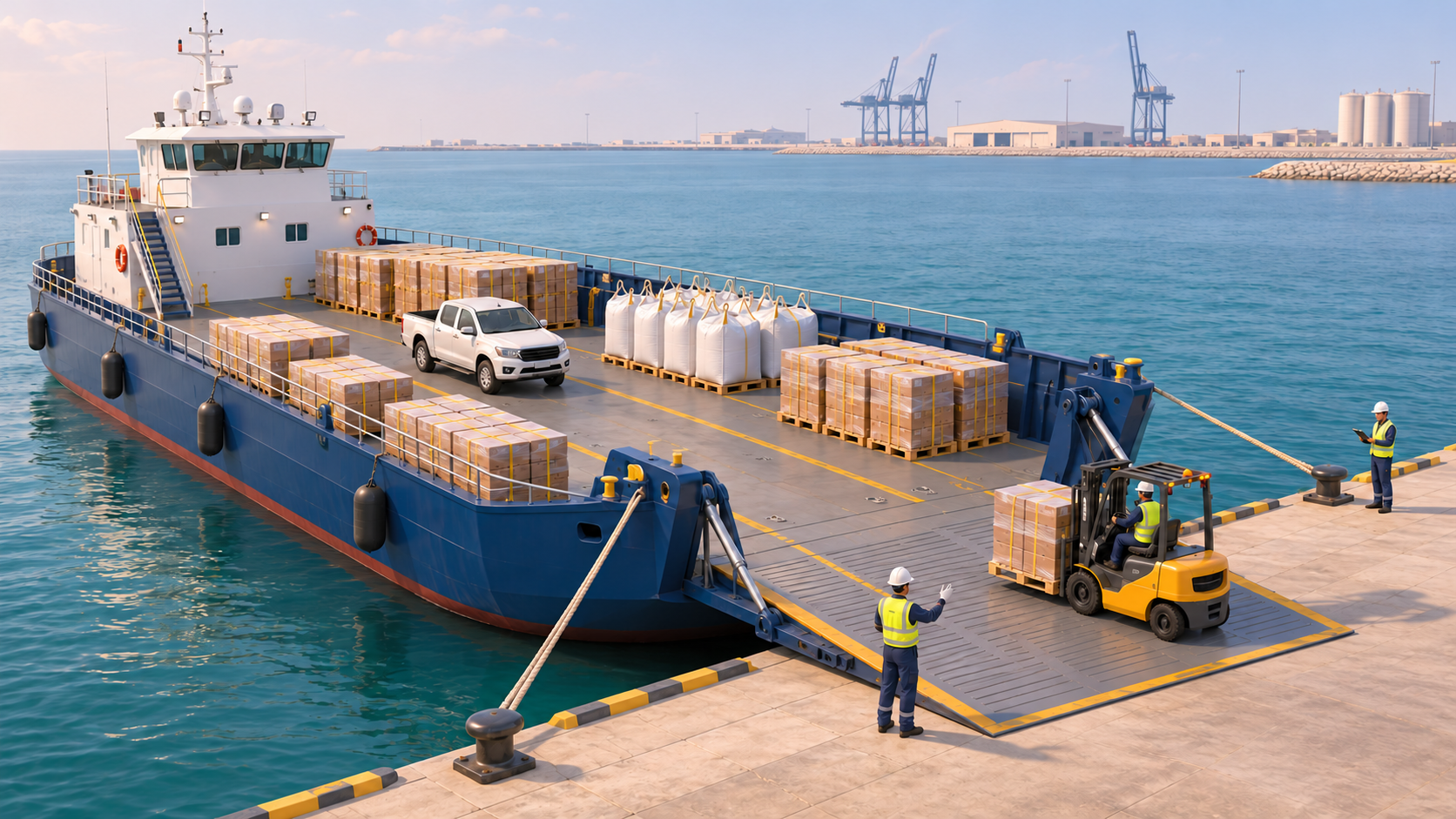
A landing craft generally has a cargo deck and a ramp that may suit certain vehicles, machinery and project loads. Ro-Ro describes rolling cargo on and off a suitable vessel. The two terms are related, but they are not interchangeable: not every landing craft can accept every vehicle, and not every Ro-Ro terminal can receive the proposed vessel.
The decision depends on usable deck space, deck loading limits, ramp capacity and slope, vehicle ground clearance, axle loads, securing points and the berth arrangement. Loading permission is only one part of the assessment. The vessel’s certification, condition, insurance and suitability for the intended voyage must also be checked.
For mixed cargo, a coordinated stowage plan keeps access routes clear and places heavy or sensitive items correctly. A cargo list by itself is not a stowage approval. Photographs, accurate weights and dimensions, lifting requirements and any special hazards should be available before vessel selection.
2. Full charter or part-cargo space?
A full charter may suit a large project, a coordinated vehicle shipment or cargo that needs a dedicated loading sequence. It can offer more control over the proposed cargo mix and voyage plan, but availability, technical suitability and legal acceptance remain essential. The charter agreement should identify the vessel, cargo, ports, permitted substitutes, responsibilities and conditions that must be satisfied before performance.
Part-cargo or shared deck space may be practical for smaller consignments when a suitable sailing is actually available. Confirm whether the price is based on weight, volume, lane metres, deck area or a minimum charge. Do not compare a charter quote with a small-lot freight rate without accounting for port handling, lashing, surveys and inland transport.
For recurring loads, agree a planning process rather than assuming a guaranteed timetable: cargo readiness, document cut-off, terminal approval, loading window and dispatch confirmation. An indicative date is not a confirmed departure.
3. Iran–Oman: route enquiries and port checks
Sirik or Jask to Shinas can be raised as a route enquiry, with the exact departure port, receiving berth and vessel to be confirmed. Public evidence of port activity or a past voyage does not establish a current Asadi Express service or a regular sailing on that pair. No fixed timetable for these requested routes is published here.
Shinas is an Omani commercial port associated with coastal cargo activity. Its general capabilities do not replace approval of the proposed vessel’s dimensions, draft, ramp operation, cargo type and berth. Obtain written acceptance before cargo is sent to the port.
Sohar may arise as a separate port option or an inland delivery point. Do not assume that a Shinas discharge includes onward delivery to Sohar, or that Iran-related cargo is currently accepted at Sohar. The receiving terminal, customs procedure, road leg and any current restrictions must be confirmed separately. Reverse-direction Oman–Iran shipments require their own export, import and voyage checks.
Onward connections to India, China and Africa
If the final destination is in India, China or Africa, identify the destination country and port before choosing a Gulf loading or transfer point. A regional landing-craft leg and an onward ocean service may require separate vessels, bookings, documents and handling arrangements. For any proposed connection through Sohar or another port, confirm current acceptance of the cargo and its origin, transfer permissions, the onward carrier and the division of responsibility. This guide does not announce a direct Asadi Express sailing to those destinations. All legs must comply with applicable restrictions; a transfer must not conceal the true origin or parties.
4. UAE ports: distinguish geography from availability
Sirik or Bandar Lengeh and UAE destinations may be discussed for future planning only within the trade-suspension notice above. A nearby port, an existing ramp or an old shipping advertisement is not evidence that a new Iran–UAE movement can lawfully be booked.
Mina Al Hamriya in Dubai and Hamriyah Port in Sharjah are different ports. Every enquiry should state the emirate, port, terminal and receiving agent clearly. Ambiguous references to ‘Hamriyah’ can lead to incorrect transport costs, documents and delivery instructions.
DP World describes Mina Rashid in Dubai as having Ro-Ro facilities. That confirms a general port capability, not permission for a specific Iranian vessel, cargo or landing-craft call. Any future proposal involving Mina Rashid needs a lawful trade basis and current terminal and marine approval. Routing through another country must not be used to evade restrictions.
5. Prepare vehicles, jumbo bags and pallets properly
Vehicles and machinery: provide make, model, quantity, operating condition, dimensions and gross weight. Clarify whether each unit can move under its own power and disclose batteries, fuel, leaks, attachments and non-standard dimensions. Import eligibility and registration requirements are separate from the ability to carry the unit on a ship.
Jumbo bags: identify the commodity, bag specification, unit weight and handling method. Packaging must suit the material and the journey; consider moisture exposure, tearing, stacking and load distribution. Dangerous goods require correct classification and acceptance. Never describe an unknown powder or chemical simply as ‘general cargo’.
Palletized and packaged cargo: state the number of packages, dimensions and weight of each pallet, stackability, centre of gravity where relevant, and lifting restrictions. Use packaging and securing appropriate to marine motion and the planned handling equipment. Where regulated wood packaging is used, check the applicable ISPM 15 requirements.
For stone, provide the type, package weight and proposed pallet or rack arrangement; concentrated deck loads and lifting points need particular attention. Glass needs suitable crates or racks, edge protection and a plan that limits movement and impact. For packaged bitumen, state the product grade, packaging, transport temperature and safety data sheet so the carrier can determine any dangerous-goods requirements. These are examples of packaged or palletized cargo for assessment, not an offer to carry loose bulk or a confirmation of acceptance.
A pre-loading condition record, photographs and a clear packing list help identify damage and discrepancies. Lashing, chocking, lifting and any survey requirements should be agreed with the carrier and handling parties before loading starts.
6. Documents, customs and cost boundaries
Typical commercial information includes a commercial invoice, packing list, commodity description, HS classification where established, origin, value, parties and destination. Depending on the goods and countries, licences, certificates, inspections or other approvals may be required. Vehicle documents, dangerous-goods declarations and product-specific permissions must be checked case by case.
Ask what the quotation includes: inland collection, loading, ocean freight or charter hire, port charges, discharge, lashing, agency, customs services, duties and taxes, storage and final delivery. Establish the agreed trade term and which party bears each cost. A freight quotation does not mean duties, insurance or customs release are included.
If a charter is proposed, review loading and discharge time, waiting charges, laytime or demurrage where applicable, cancellation terms and allocation of weather or port delays. Cargo insurance and carrier liability are different. Check the proposed policy’s geographical scope, exclusions and any war-risk terms with the insurer.
7. From enquiry to an approved loading plan
First, send a complete cargo brief and the preferred origin, destination and ready date. Next, establish whether the shipment is legally permissible, then confirm a technically suitable vessel and receiving terminal. Only after these checks should the quotation, responsibilities and provisional schedule be finalized.
Before dispatch to port, obtain instructions covering documentation, cargo cut-off, delivery location, inspection, loading equipment and securing arrangements. Confirm who will issue the transport document and how updates will be provided. During current regional maritime uncertainty, recheck official notices, voyage risk and insurance close to departure.
At destination, align the consignee’s readiness, customs procedure, receiving equipment and inland delivery with the discharge plan. A ship’s arrival is not the same as cargo being cleared and ready for collection.
Questions before requesting a quotation
Can I book Iran–UAE cargo from this page?
No. This guide does not offer a current Iran–UAE booking. The official trade suspension described above must be respected. Any future movement requires a lawful basis and current approvals.
Is there a fixed Sirik–Shinas or Jask–Shinas sailing?
No verified fixed schedule is stated here. Submit the cargo details so that route feasibility and actual availability can be assessed.
Can one shipment include vehicles, pallets and jumbo bags?
Possibly, if the cargoes are compatible and the selected vessel, deck plan, securing arrangements and terminals accept them. It is not automatic.
What is needed for a useful quote?
Cargo description, quantities, package dimensions, gross weights, photographs, readiness date, loading and delivery points, and any dangerous-goods or special-handling information.
Prepare a clear cargo enquiry
Send the details once so the route, vessel and cost assessment can be based on the same cargo brief. Do not send cargo to a port before receiving shipment-specific instructions.
Explore Asadi Express services
Ocean freight · Iran–Oman logistics · Contact the team
Sources and scope
Official sources support the restrictions and general port context, not an Asadi Express sailing or a guarantee of acceptance. Information checked on 7 November 2026. Requirements may change before a shipment. This guide is general planning information, not legal, customs or insurance advice.
UAE Ministry of Foreign Affairs announcement via WAM, 19 August 2026
Oman Ministry of Foreign Affairs: Port of Shinas, 20 September 2026
Routes


